Sunday, 22 March 2015

Days of Significance- March 21st

Amira was celebrating Nooruz


When we moved to Kyrgyzstan the first time 10 years ago, one of the things I most looked forward to was Nooruz. https://en.wikipedia.org/wiki/Nowruz We had had some Uzbek friends in Idaho who told us about the holiday and invited us to their celebration and I wanted to see what it was like in Kyrgyzstan.  We've since celebrated Nooruz many times (that's the Kyrgyz spelling- there are lots of variations depending on what part of the Iranic or Turkic world you're in) and one of my favorite things to do is to eat laghman.  They're long pulled wheat noodles that probably orignated in China.  These specific noodles aren't necessarily traditional for Nooruz, but eating noodles is.  I love to celebrate this holiday, not only because it reminds me of being in Kyrgyzstan, but because it's been celebrated for thousands of years by many different people.

This version of laghman is a simpler way to do it than the flung and folded way.  More power to you if you can pull that off.  Most people in Central Asia make laghman this way.

Mix about 4 cups all-purpose flour (this is the only recipe where I don't use whole wheat flour- it just doesn't work well), 2 eggs, 1 tsp salt, and enough water to make a stiffish dough, then knead it a bit.  You can do this in a mixer or food processor if you like.  Shape the dough into a ball, cover, and let sit for at least two hours. 


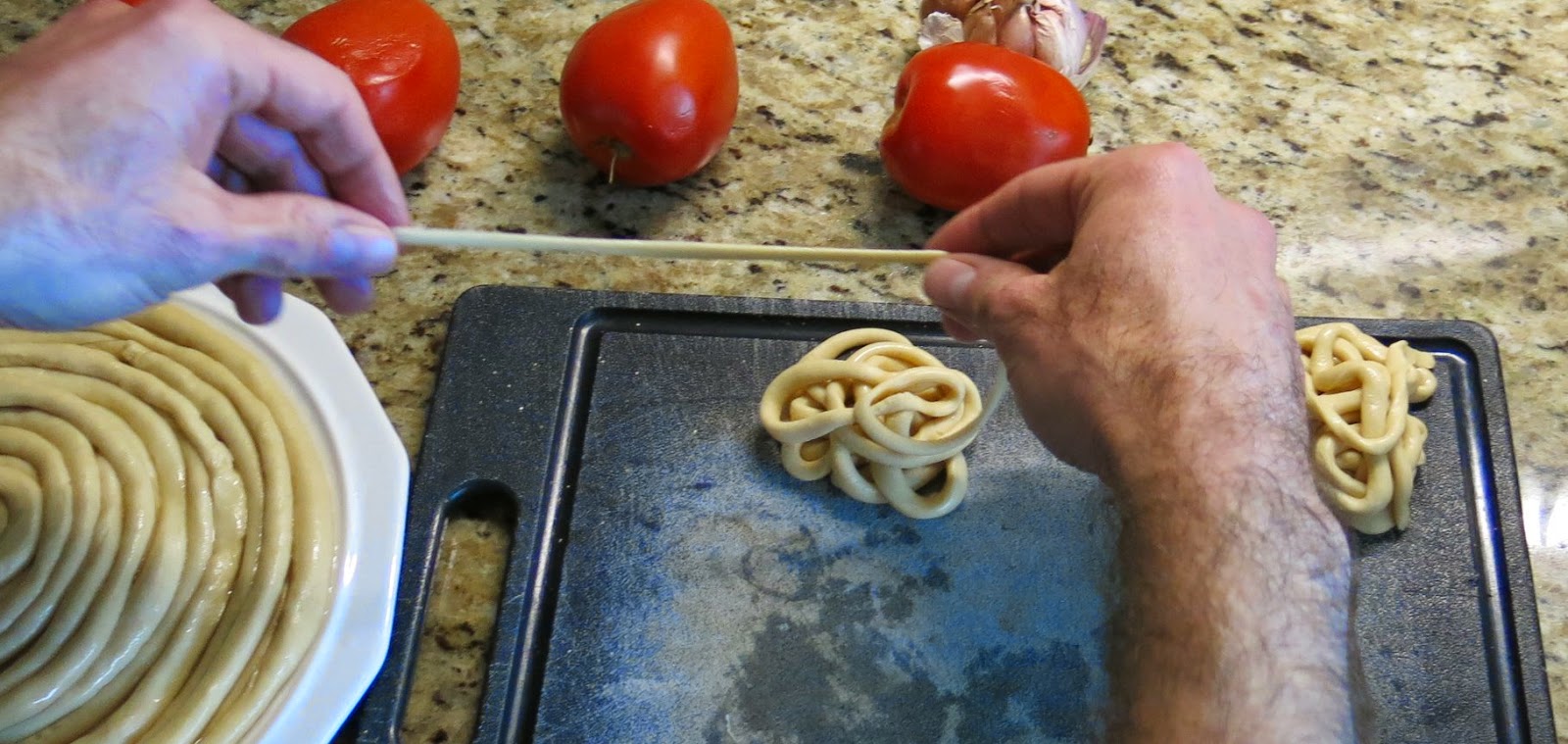
Break off walnut-sized pieces of dough and roll them into long, pencil-thin strips. After forming each strip, oil it, then coil it on an oiled plate (start in the middle and work your way out, then when the plate is full, start a second layer till the dough is all used up). Cover the coiled dough mound with plastic and let it sit till you're ready to cook the noodles (you want to let it sit for at least 30 minutes and much more time is better- at least two hours).  As you can see, you don't have to be perfect.
Take each noodle one at a time and pull it with both hands into a very long, thinner noodle. Work carefully so you don't break the noodles. Leave each pulled strip in a separate little heap on the counter until the water boils.
Holding your hands out, about 18 inches apart with the palms facing each other, take the ends of three or four little heaps together between your thumb and your palm and run them around the back of your hand. Bring the dough on top of your other hand and then down across the back of your hand. Bring the first hand around to pick the dough up again on top of the hand and then around the back. Repeat that motion to make a sort of figure-8 with the noodles. 
When you have all three strands wrapped around your hands, pull the noodles again by moving your hands farther apart (don't break them, but do give them a good pull), then drop them off your hands into the boiling water.Stir the noodles to prevent sticking. They'll float to the top as the water comes back to a boil. Fish them out with the strainer about a minute or less after the water boils again. Dip them into the cold water, then transfer to a plate. It's easiest to keep each batch on separate plates because the noodles are so long that they're hard to get out of a communal bowl.

If you're making a lot of noodles, they'll get cold before you get them all done, so briefly dip them back in the hot water before serving to warm them up.  Or you can fry them which is what my son prefers and I have to say that's a really tasty option.

Get a large pot of water boiling and have a bowl of cold water and a big strainer scooper thing (I don't know what they're called) ready. While the water is getting hot, start stretching the noodles. Take each noodle one at a time and pull it with both hands into a very long, thinner noodle. Work carefully so you don't break the noodles. Leave each pulled strip in a separate little heap on the counter until the water boils.


--------------------

Rose-Marie was celebrating Mabon.

Once it stopped begin too hot to move without putting the air con on, I got stuck into the very much needed Mabon cleaning. It's not that I'm fond of housework, or anything, but by the time Mabon comes around, I find myself glad to be able to get stuck into it. We worked on it a little each day for over a week. I didn't want to inspire rebellion in my daughter!

Here's a pic of my other trusty cleaning companion, the vacuum cleaner that used to be mine, that I handed over to my mother because she has more carpet and a house big enough to fit it in!


Hooray for the vacuum cleaner! Spiders, you must rebuild!


We also harvested. This year, living somewhere with better quality soil and more reliable water, we finally got enough popcorn to eat, not just to plant next year! It looks pretty, doesn't it, sitting in my lovely fruit bowl made of red gum burl. We haven't eaten any yet, but we can and that's nice to know! I will certainly plant more this summer. 6 plants wasn't enough. The plants are so large, but only produce about two cobs. That's not going to keep anyone in afternoon snacks for long, is it?


This being temperate Australia, it is not only a time of harvest. We get a winter growing season, so it is also time to start off seedlings. Daughter and I planted out some old seed we had left over on Mabon, expecting nothing to germinate and for us to have to take a trip to a nursery for seedlings come Samhain, but lo! We had much better luck than expected! Look at that! 


____________________
Amira is a peripatetic homeschooler currently living in Mexico.  She loves food, books, geysers, ruins, rain, and rocky beaches. She blogs at http://amiralace.blogspot.com.au

Rose-Marie was one of those enthusiastic planners who began researching when she was pregnant with her first. She wanted to homeschool because it sounded like an affordable adventure, then she met her kids personally...


Sunday, 1 March 2015

Experiences of 'Barton Reading and Spelling' with Dyslexic Kids


My kids were not successful at learning to read using "whole word" and "sight word" instruction in school, and we wasted years trying. Tutors and extra studying after school didn't help either, and in some cases made our situation worse! After completing evaluations and finding out both children were dyslexic, we were told our best bet was to find a system that was Orton-Gillingham based; essentially phonics. We decided the best thing to do, at least for the moment, was to use a program that could be implemented at home. Someone had recommended Barton Reading And Spelling (http://www.bartonreading.com) I was hesitant at first because it has a reputation of being rules based and I knew that my children did terribly when forced to memorize rules. Now, while it IS rule based, I have found the program to be amazing.

First, Barton is probably the easiest for a layman to implement. It comes with tutor DVDs, a great teacher's manual, and lots of on-line support. Susan Barton herself is more than willing to discuss concerns by e-mail and phone. After extensive research, it just seemed that this program would give us the best chance of implementation at home.

I will admit to disappointment and felt almost insulted when we started the first level. It seemed SO basic and almost silly going back to the beginning with sounds, and not even sound-letter association, especially for my older child who was already in 6th grade at that point. I honestly considered sending it back. My kids were very articulate. They couldn't possibly have sound discrimination issues, could they?

Having committed good money to the purchase, we decided to try the program anyway. Once we started and I committed to following the recommendations and script, I began to see changes began pretty quickly. I had been wrong. The very, very basics presented in Level 1 were actually where things had started to go wrong for my children, only no one had known it. Not me. Not the teachers. Not even my mother, a reading specialist, who is very bright and had years of teaching experience.  Barton Level 1, as basic as it looked, was the key that finally started to unlock all the more advanced skills in reading and spelling.

I am still amazed at how well thought out, laid out and successful this program has been for us. Over the past year I have watched the transformation in understanding of sounds and words and language with my kids and it has been amazing. My daughter, in particular, made more progress in reading and spelling with this program in just a year and a half than she did in a very long 7 years of instruction in a classroom setting and with tutors.

That being said, this program is not a miracle system. It won't work for every single child. And not every child will progress at the same pace. Every child is different so the pacing really depends in part on the tutor, how often the tutor works with the child and more importantly the underlying strengths and weaknesses of each child. Even with an umbrella diagnosis of dyslexia for both kids, they have very different underlying strengths and weaknesses so their pacing and individual success through the program has been different.

My advice? If Level 1 clicks with a student within 2-3 months, stick with the program. Many kids will even get through Level 1 in a week or less. If they haven't even finished Lesson 2 of Level 1 after 2-3 months, perhaps try something else. Even for those children suited to this program, progress through the levels will vary. It is not unusual for students to take a year or more working through Level 4, which is probably the most challenging.

One thing to keep in mind is that the program keeps adding on to previous skills and by the time all 10 levels are completed, the student should be functioning at a high 9th-10th grade on reading/spelling. In other words, this program is not just for the very basics of reading remediation. It can carry a student through into High School level material. It can also be used with a child that is not dyslexic, although they will almost certainly move through the program at a MUCH faster rate than a dyslexic student. The levels are not equivalent to grade levels, though. They are building blocks. Each level is needed to build on for the next level so even an older student will usually need to start with Level 1.

When I first started it took a while to wrap my brain around this system. I know others who think this type of program just seems intuitive and I know some who get irritated at the Teacher's Manual and the tutor support DVDs, feeling they are too basic, break things down too much. I found them absolutely necessary for me to understand this system. Once I did, and actually followed what Susan Barton says to do, insisting the kids follow the system even when some stuff seemed silly, I could see the method working. I could see the kids making connections, and improvement in reading/spelling/grammar all began to manifest.

Each level has a lesson for each rule or concept being taught for that level, as well as built in review of prior concepts/rules. As I've said, the first 2 levels seem very basic and are quite short compared to the other levels but are usually absolutely essential for successful remediation. After level 2, each level contains between 10 and 14 lessons, with each lesson broken into parts (usually A-Q.) Each part provides a different way of approaching that rule/concept. The student does some work orally, some with tiles (manipulatives), some written in isolation, some written in phrases, some written in sentences. Some is reading individual words, some is reading off of lists of, some is reading phrases, some is reading sentences, and some is in reading passages, etc. Helpfully, if the student is going through a part and does not seem to be grasping the rule as presented in that part, the Teacher's Manual has additional words/sentences/tile activities that can be used for additional exposure or additional review of that component. 

Throughout the various parts of that lesson (and lessons can take just a couple of hours, or days or even a couple of weeks or more to complete, depending on the student and the lesson) the student is exposed to the new concept in many, many different ways so that it can be internalized and become automatically applied. If, by the end of the lesson, the child is NOT fluently reading/writing the words (nonsense AND real words) in that lesson, then you repeat the lesson with additional words that follow that rule/concept until reading/writing IS fluent for that rule as well as prior rules. There are tons of extra practice pages and games available on the Barton site if the ones in the packet aren't enough. There are many companies now that provide supplemental materials such as card games, board games, readers, etc. that support the levels of Barton and can be used to liven up the lesson, do additional review, help solidify concepts, etc. Some are free, some cost a little money and some cost a lot. At the end of each level you have the option to give a test to confirm they have internalized the rules for that level. If they don't do well in certain parts, it is clear which part they need review and you just go back and review that particular section, without repeating the entire level.

Grammar, punctuation and sight words are also addressed, but very gently in the early levels.
This program is supposed to replace ALL other Language Arts programs for the student (except for outside literature studies where the child either listens to audio books or the parent reads to them) until after Level 4, at which point a formal writing program that is separate from Barton can be used (she recommends the main program from the Institute for Excellence in Writing but there are many others to be found out there in internet land) and the student can be given some assigned readings through controlled sources. 
 
Over all, I find Barton to be a very thorough, effective way for a parent to successfully help their dyslexic child learn a better way to read and spell. I have not found, in all my years of research, a better system for a parent with no Orton Gillingham based training to implement on their own. I wish we had started with this program far sooner than we did.


____________________
Catherine is mother to two darling children, and gets around her business in the southern USA

Saturday, 21 February 2015

Folk Music Offerings


Some of the 'Investigate the Landscape' authors and a few of their online buddies were talking about folk music the other day. We thought we'd share the offerings with you, our lovely readers, because some of them might be new to you too.


Here is a North Korean version of 'Arirang':
https://www.youtube.com/watch?v=7FlXH9CGnvw&list=RDQMHke0YEQifqw

And he's a South Korean version:
https://www.youtube.com/watch?v=U1MDBeCCpX4

Wikipedia will give you the lyrics: http://en.wikipedia.org/wiki/Arirang#Lyrics


An Australian contribution, with a note from the contributor: "The youtube clips drive me nuts when they have pictures of kangaroos when he's singing about kangaroo paw. He's singing about the flower, not a roo's limb! (I should get over this, but I haven't.)"

This is what a kangaroo paw flower looks like, though they do come in other colours too.


Here's one from Serbia:


An Eastern European Jewish offering:


A couple from the US:
https://www.youtube.com/watch?v=1vrEljMfXYo

https://www.youtube.com/watch?v=T1tqtvxG8O4

https://www.youtube.com/watch?v=OjN4_A5UqQA

https://www.youtube.com/watch?v=GSYNRlVqjfA

This one is from the US too, but, while this piece of SCA (Society for Creative Anachronism) filk is packed full of well meaning advice, it isn't one to play for the kids because they are far too young to need this kind of advice...
https://www.youtube.com/watch?v=D2k5c3WoiTI


This one is an Egyptian nursery rhyme type song, with lyrics here: http://www.mamalisa.com/?p=273&t=es&c=43
https://www.youtube.com/watch?v=ON-S_UuzKbU


And I have to end with this one from Stanky and his Pennsylvania Coal Miners Polka Band because I think it is hilarious. I fully understand you may not.
https://www.youtube.com/watch?v=KtIQaLQA0-8

Come on though, isn't that one even better than this one here? I can't even watch it all the way though. *weeps*
https://www.youtube.com/watch?v=uWu4aynBK7E


Do please share your favourite folk song Youtube clip with us in the comments section below!


Saturday, 14 February 2015

Give Away Winner!


And the winner of last's week's give away is lucky woman named Jen.

The book will be in the post this week. :)

Saturday, 7 February 2015

Days of Significance- 2nd February 2015

A few 'Investigate the Landscape' authors are celebrating something today!


Rose-Marie celebrated Lammas

Feb 2nd, give or take a day or two, is Lammas for those of us in the Southern Hemisphere who follow the neo-Pagan Wheel of the Year. It is supposed to be the first of the three harvest festivals, but that is not quite reality in my area. Our growing seasons are obviously not the same as in Europe, where the 'Wheel of the Year' came from, and at this time of year the harvest for some crops is finishing up around about now (give or take a month or two) and others are being sown (give or take a different month or two!)

In my home garden, I've been harvesting leeks for several weeks, but nothing else is ready! But I still wanted to harvest something, so Daughter and I made our second attempt at cheese making. Here's a pic of the cooling ricotta! Or what will be the ricotta when it has cooled and drained!


The intention is to eat it with the first ripe tomato from my mum's garden. She does not celebrate Lammas herself, but is all in favour of home made cheese and home grown tomatoes. I hope to have better luck with tomato growing myself next year. This year, none of my seeds even sprouted and I didn't notice until it was too late to try again.


Now, if you are waiting for the devilish, baby eating part of my Pagan celebration, I'm afraid you will be disappointed. The other thing I do for Lammas is even more mundane than cheese making. I wash blankets. See?


Lammas may well be the beginning of autumn in the Northern Hemisphere, but we've got another month of summer, at least, and the worst part of summer too. Lammas is the last spoke of the Wheel I can be sure to get my blankets dry. Alain de Botton talked about holy days as being appointments with ideas. In this case, I think that is a very good idea. It would be so easy to forget to wash blankets and wouldn't I regret that when the weather cools down and I pulled out that nice fluffy blanket featured above, and found it too dusty to use and the weather too drizzly to wash it? Yes indeedy, so Lammas is my appointment with blanket washing.

______________________________

Amira celebrated Candalaria

I live in Mexico right now so Candelaria is the holiday for February 2nd.  For a few years now, starting before we lived in Mexico, I've been taking the tree down on February 2nd.  Not only is it one of the traditional end dates for the Christmas season, I also like to have the light from the tree during for the three dark months of the northern hemisphere.  It's not as dark in central Mexico as it is farther north, but I like the tradition anyway.  February 2nd is still firmly winter in other places I've lived like Idaho and Kyrgyzstan, but it's the end of "winter" in Mexico and we're starting to warm up for the hot, dry spring.

I love putting the tree up and taking it down because we have ornaments from so many different place we've lived.


Another tradition that we've picked up in Mexico and that we'll keep after leaving is making tamales on Candelaria.  On Kings Day, January 6th, most Mexicans eat Kings Bread, or Rosca de Reyes, that has a little Jesus figurine baked into it.  Whoever gets the figurine has to provide tamales for everyone on February 2nd.  The tamales come from an older pre-Hispanic Aztec festival in February that honored Tlaloc, the rain god.  Most of the rituals from all of those festivals aren't practiced anymore, but a few Christian holidays like Candelmas and especially All Saints Day have Mexican traditions included. So I made horneados and lots of steamed tamales like pollo verde, chocolate, and rajas con queso.  Yum.

_________________________

Aura celebrated Imbolc

I use the sabbats as well as other holidays as a way to focus my energy and thoughts during the different times of the year. For me, Imbolc is a time of hope, of hidden beginnings, of things stirring underneath the surface. It's a good time to focus on beginnings, to think things through, to look at where I'm at now and where the path I'm on will lead.

I try to associate the sabbats with something more familiar to me, so in this case, it would be Groundhog Day. This is the time that, much like the groundhog looking for his shadow, I can look around me and forecast what is likely to come. (Talking about the idea behind the groundhog seeing his shadow...not that I actually believe the groundhog is going to predict the onset of spring.)

Below is a couple of pictures of my altar...which simply looks like a little seasonal home decor, except that each item has meaning and is there to remind me of what the “theme” is for this season.

f64de66454977d53f2a28bf94f9fbe8a.jpg

83542bd569e8790abd728df0b9e18785.jpg


The wall art is a circle and a spiral, representing the wheel of the year and the changes it brings. Each turn of the wheel brings new things into focus, but everything is connected.

The hedgehog is the closest I found to a groundhog. It burrows, but not as deeply. And it's really cute! Here's a link talking about hedgehogs and their spirit meanings: http://spirit-animals.com/hedgehog/

African violets represent spirituality. I'm still trying to get my violet to bloom again, but at least she seems to have recovered from being repotted and appears to enjoy her spot at the center of my altar.

The two-tiered stand with bowls was a wedding gift. It’s the closest I have to a well and will serve as a stand-in. The well is a symbol of Brighid, the goddess associated with Imbolc. You can read more about her here: http://www.paganspath.com/magik/celtic/imbolg.htm. Personally, the gods and goddesses are not beings that I worship or even believe really exist. I consider them representations of differing aspects of The Universe. They bring to light many things to think about and consider: lessons to be learned and principles to be applied.

The top bowl holds moonstone, which is associated with the goddess. I particularly feel the need to have more of her influence in my life. It is a definite counter to balance out the patriarchal influences.

The bottom holds pinecones and sweetgum balls. Both are seeds, of a sort, particularly easy to find this time of year (at least in my backyard they are!) and represent beginnings and rebirth as well as abundance. Both are protective and purifying/repelling of negativity. Both are considered masculine, but I offset this by placing them inside a bowl, which is feminine. I don’t wish to ignore or to shut out the masculine, because it is as necessary as the feminine, but simply to balance it out.

I always have at least one candle, to represent the Universe, and to represent magick and spirituality. In this case, I have one white candle.

Imbolc is sometimes called Candlemas or the Festival of Lights (though they may actually be different cultural or religious observations of the same turning of the wheel). The candles and lights symbolizes the warmth of the flame banishing the cold of winter and the coming of spring. To represent the coming thaw, I have lighted floral stems mixed with willow branches. Willow is also associated with Imbolc, though I haven't researched it that much...still, I like the lights mixed with the willow stems.

There are a lot of personal preferences mixed in my altar. Some things I place on it just because I think it adds a “finishing touch.” But altars are personal things, and I believe it’s okay to add things just because it feels right to you. The spirit often communicates very subtly. In my process of learning, I have often found that my attraction to something actually reflects a spiritual significance to which I was previously unaware.

I will leave this altar up until Ostara, March 21, when I will change it to reflect that sabbat and the upcoming Easter holiday.

____________________

Rose-Marie was one of those enthusiastic planners who began researching when she was pregnant with her first. She wanted to homeschool because it sounded like an affordable adventure, then she met her kids personally...
Her young daughter has Echolalia, dyscalculia and some processing issues so isn't speaking fluently yet; but she is making good progress as they work and play in Central Victoria, Australia.


Amira is a peripatetic homeschooler currently living in Mexico. She loves food, books, geysers, ruins, rain, and rocky beaches. She blogs at http://amiralace.blogspot.com.au


Aura is a homeschooling mom in North America and an eclectic witch who is still “in the broom closet” with most who know her in person. She does not ascribe to any particular religion, believing that spiritual paths are unique and personal. She enjoys learning and writing about the spiritual and magickal.

Give Away!


Hi there Everyone!

Welcome to 2015! Yes I know, it is February. Sometimes getting into the groove takes contemplation. Sometimes even procrastination…

But to get into the blogging mood, we have a giveaway!

Late last year an article came up on my FB feed about the republishing of the first ever book of Indigenous Australian stories, "The Legends of Moonie Jarl." I thought this was so exciting, and so very much worth supporting that I bought one not just for my daughter, but for one of you too!

Here's their site:
https://www.indigenousliteracyfoundation.org.au/ilf-proud-to-republish-australias-first-aboriginal-childrens-book.html
If you don't win this one, you can go there and buy a copy!

Now, to enter:

1. People don't get their prizes if they don't leave a way to contact them!
2. Yes, of course this is open to anyone around the world. Landscapes stretch all the way around the globe, do they not? Plus, paying international postage is my hobby.
3. If you're answering on here, rather than the FB page, do make sure you fill out the captcha thing, or your response may be lost.

4. Tell us who the Indigenous creator spirit is of your area, or if that info is long lost, look one up on Wikipedia and find an interesting one to share. :)

Winner will be chosen next Sunday.
Book will be posted when I go to the post office.
I will cross my fingers that the Post Fairies deliver the parcel without mishap, but they aren't our bestest ever friends in the whole world, so we can't guilt trip them into *ensuring* they do.


Sunday, 28 December 2014

December 2013- High Summer

(First published at Sandbox to Socrates http://sandboxtosocrates.wordpress.com)


proxy.jpg
Age 6- Grade Prep


"That was a bearded dragon. It crossed the road at the Hattah Lakes. The he climbed up the bank and behind the tree."


Again Daughter has combined objects of interest from St Clair and Steavenson's Falls into one picture. In the middle of the picture there you can see a flower with a purple seed pod. It must have been some kind of native pea. I was interested because I don't ever recall seeing plants in various states of flowering while also producing seed pods.


This was drawn from Lake Nillacootie, which is not one of our usual haunts. We were there for a break up party with one of our homeschool groups. This is a picture of a dead cicada.
"The cicada was dead. There were others being noisy up the tree. Those ones were alive." (Of course they were. Sometimes this girl is too cute. :) )


____________________
Rose-Marie was one of those enthusiastic planners who began researching when she was pregnant with her first. She wanted to homeschool because it sounded like an affordable adventure, then she met her kids personally...


Her young daughter has Echolalia and some processing issues so isn't speaking fluently yet; but she is making good progress as they work and play in Central Victoria, Australia.